There is no need to be in a hurry to grow up!
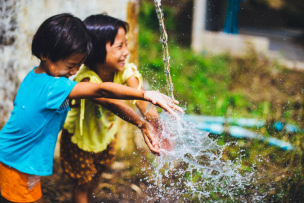
"Grow up!" is one of the standard adult rebukes. Another is, 'Don't be so childish!"
Teachers know more about their subjects than children do, but all too many of them seem to have forgotten much of what they knew when they were children themselves. They have lost their intuitive empathy because they were not taken seriously, and they have lost their healthy curiosity because they have been obliged to learn material that holds no interest for them.
Democratic Decision-making

Democratic decision-making in schools, if it exists at all, is usually limited to small issues such as the organisation of a party or the colour of the classroom walls. Even in schools where the students interview applicants for staff appointments, their role in the final decision is usually only advisory, not participatory. School rules and the curriculum are definitely decided by adults, and any suggestion that it should be otherwise is normally rejected as ridiculous.
Room 13
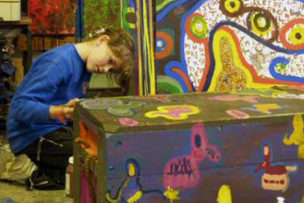
Room 13 is the Scottish primary school art room where the children run their own affairs, appointing and paying their own teacher in residence, keeping their own accounts and exhibiting their work in, among other places, the Tate Modern ...
Libertarian Education, March 2005
Education for Freedom
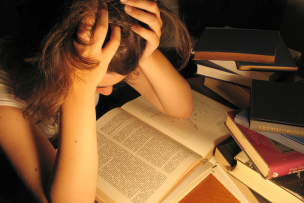
Education is being reduced to forcing as many children as possible to take as many exams as possible, regardless of individual needs, talents or interests ...
Freedom, 2005
Freedom in Learning
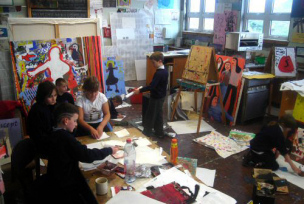
People who are frightened of the idea of freedom in learning usually believe that if you allow children freedom to choose what to learn, they will choose to learn nothing. This is exactly the opposite of what actually happens ...
School Target-setting

Target-setting is a government strategy for appearing to solve a problem without actually having to do anything. Unfortunately it does require other people to do things, and can have damaging effects ...
In conventional schools children are literally prisoners: the law keeps them in
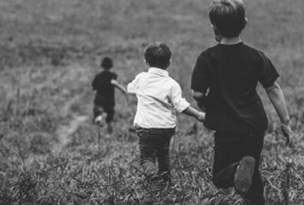
Learning according to inclination is not an option; children's inclinations are not considered relevant; adults tell them what they must learn.
All over the world there are conventional schools that ignore children's curiosity, suppress their energy and overrule their generous moral impulses. And all over the world, as I have at last discovered, there are people who have seen the damage that this does, and have set up schools that are different.
Unhappy at School
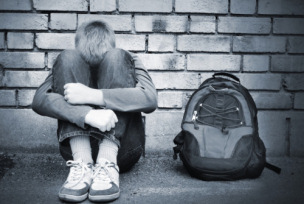
Everyone wants to be happy, just as everyone wants to eat, but for many children school and happiness are simply incompatible ...
What Children Learn
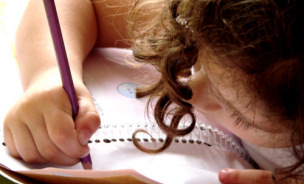
Do they actually all want to learn? They badly want to learn. But something new, something exciting. Something that they don't know already. And something that they can make use of ...
Respect Children

Sit up straight! Pay attention! Stop fidgeting! It’s you I’m talking to! Don’t make a long face! Don’t answer back! Take that out of your mouth! Do as you’re told!
Imagine that it is actually you I am talking to like that.
Even if you had respected me beforehand, since you had no reason not to, you would by now be antagonised or even angry. Any respect you might have felt will have been overwhelmed by a fierce dislike.
Grammar Schools

The Prime Minister is proposing to encourage the creation of more grammar schools, in order to increase social mobility.
A moment's consideration shows that this is ridiculous to the point of absurdity. Grammar schools, which select children according to their educational achievements by the age of eleven, automatically exclude the majority of the age-group. Rather than increasing social mobility, they actively prevent it.
Alternative Education
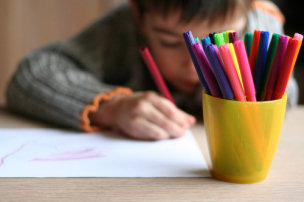
Conventional education tries to turn you into something that you are not, and alternative education helps you to develop what you are ...
School and Society

Traditional schools, instead of modelling an ideal society, model a society that is worse than most, a divided society with a defined, dominated underclass from which it is impossible to escape ...
Progressive Education
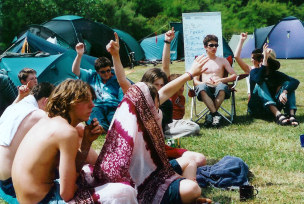
This entails equal status for children and adults, who must share responsibility for the running of their schools, and freedom for children to decide how they will spend their time...
Lord of the Flies

The so-called “Lord of the Flies” syndrome is based on a misreading of the novel. This repudiation of the standard interpretation has appeared in several publications...
The Summerhill Journal, Young Minds and elsewhere, 2004 and 2005
Patricia Amos

In 2002 Patricia Amos was sentenced to 60 days in prison, because her teenage daughters were not attending school. This article was written for KagekiAsakura, of Tokyo Shure University, to explain the situation to the horrified Japanese ...
Written in 2002 for Kageki Asakura of Tokyo Shure University.
Open Learning: an introduction to the work of Falko Peschel

Falko Peschel is both an academic and a practising teacher. He developed his theory of open learning while working for four years with a class in an ordinary primary school ...
Libertarian Education, January 2007
Bullying in Schools

The suicide of Ayden Keenan as a consequence of bullying at school was reported on Channel 4 News on June 19th, 2013. The fact that this is not a sensationally unusual story is shocking enough in itself, but what made this case different was that Shy Keenan, Ayden’s mother, had made any number of attempts to get the school to do something about the bullying, and had always been turned away. On the programme she told us that Ayden had approached one of his teachers who had told him bluntly that nothing more could be done.
Good News for Francisco Ferrer
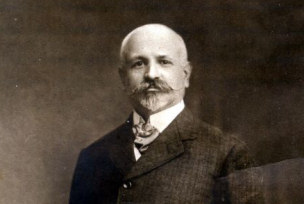
Published by the Manchester University Press in Changing Anarchism, edited by Jonathan Purkis and James Bowen, this article shows how many of the recommendations made by the Spanish anarchist educator, Francisco Ferrer, at the beginning of the 20th century have been put into practice over the years in many different schools.
Not available on line
ISBN 0-7190-6694-8
Inviting Children to Participate

An account of the Voice of the Children panels in Bergen in 1990 and Rio in 1992.
Not available on line
Published in Educational and Child Psychology, Vol. 11, No. 4, 1994, by the British Psychological Society.
ISBN 1 85433 162 0: ISSN 0267 1611
Happy at School

In traditional schools most of the children are happy for most of the time. However most of them are also sometimes frightened or bored or over-stressed, or any combination of the three. Some of them are miserable almost all the time. None of this is necessary.